As
said, I am getting back to talking of
Orhan Pamuk [OP], yet this is now in conjuction with talking of
Naguib Mahfouz [NM]: the two most recent writers that have enchanted me with their crafts; as I wrote of their 4 common features, here's what I was referring to:
- the fact that both of them wrote stories from and about times and places which are very different from our daily lives,
- their crafts having won each of them the Nobel Prize for literature,
- that they both belong to the very large family of Islam-touched patterns of thought,
- and that they've both written stories of stories, of transformation.

Orhan Pamuk's novel is a philosophical thriller constructed around the clash between [two] views of artistic meaning, which is also a chasm between two world civilisations. Great fiction speaks to its time; in the week of the American suicide bombings, this outstanding novel clamours to be heard.
Frankish novelty is represented by the brilliance of Venetian painting, which sweeps all before it with its portraits of faces set on achieving death-defying immortality through the palette. On the other hand is a tradition which seeks to record the objective truth as it might appear to Allah's dispassionate gaze (and may therefore be a subtle form of blasphemy). We all know that appearance deceives. A fool, thought Blake, sees not the same truth as the wise. But even the wise see differently. Islamic art took - and takes - its iconoclastic cue from that fact.
What followed was the rejection of the image in the name of a higher realism. Horses saunter in unison with forelegs simultaneously, "unnaturally", extended. What matters is the perfection of the single unvarying red, compounded from the dried beetle found in the hottest part of Hindustan - not the Frankish delicacy of graded shades. Pamuk's miniaturists grow blind in the obsessive service of art.
This fragment, think I, probably does a much better job appreciating
My Name is Red than I could at the time, and you can keep reading Hywel Williams's review
in The Guardian.
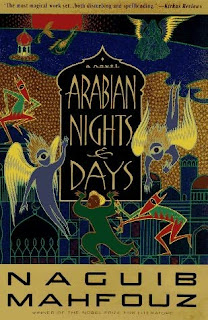
Arabian Nights and Days is [yet] a[nother] novel written in the episodic form that Mahfouz came to favour. In it he chooses tales from the classic Thousand and One Nights and reforges them into narratives dealing with those themes he was always occupied with: good and evil, man's social responsibility, and, increasingly with time, death. The novel is set in an Arabian Nights atmosphere, but many of the issues relate to Egypt's present problems: the corruption of those in power, social justice and the rise of the fundamentalist movement. [...] Mahfouz also rendered Arabic literature a great service by developing, over the years, a form of language in which many of the archaisms and cliches that had become fashionable were discarded, a language that could serve as an adequate instrument for the writing of fiction in these times.
- as summarised
here.
From bringing the stories to their natural political connotations to reversing that same process, these two controversial story-tellers tend to help one remember not only that there's always more than meets the eye, but that visions and worlds [of thought, and not only] had been built on such concepts; and, of course, there are always the juicy historical bits to add to the picture.
My fondness of controversial Islam writings has been raised to a new level!
Labels: analysis, bits of history, books, Egypt, Islam, Nobel Prize, Turkey


