Wednesday, October 22, 2014

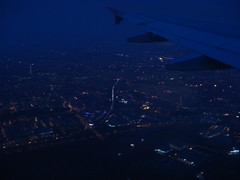
Leaving Timisoara

A wonderful quote from A Goldsmith of Words: “We leave something of ourselves behind when we leave a place, we stay there, even though we go away. And there are things in us that we can find again only by going back there.” Amadeu de Prado died in 1973 of the rupture of an aneurysm in his brain, of which he’d been long aware.
From here.

Labels: , , ,

Thursday, May 05, 2011

JBA: When the going gets tough.. [re-edited]


courtesy of my flickr, certainly

Labels: , , ,

Wednesday, December 23, 2009

Some Days are All About the Aerial View

DSC04916

Labels: , , ,

Monday, November 30, 2009

This is not about Relativistic Electromagnetic Mass Models

But it is about a Dust Distribution Theory: MY Dust Distribution Theory.
And no, neither is it about charged dust. Unless that charge refers to its quality of making us discontent of having it around.

What am I talking about here? - The common house dust.
What about it? - I do have a Theory, more precisely a Distribution Theory. What I have been noticing in my observations is that:
1. Dust is much more visible when expecting someone's visit compared to days when such visits are not expected. That is to say that the visible distribution of dust is dependent on visitors.
2. Dust piles up much more quickly when I am busy doing some-important-thing else. That is to say that the speed of dust distribution is dependent on the density of my own schedule.
3. Lastly, the distribution of dust technically changes in situations where I am here by myself compared to those when I am here +n, where n>0, n being an integer number [not a fraction]. This is to be understood in the meaning that dust distributes differently [less visible, possibly more hidden] when I am here by myself, compared to situations when I am here in at least one other person's company [more visible, in the absence of any dust storms or other visible Dust Distribution events occurring].

Drawing the line here is formulating the Theory, namely: Dust distribution has its own will, and it has decided to act against me. It will increase visibility in shameful situations and subsequently decrease it when we're here by ourselves.
That's It, Dust! I said it, and now the World knows it! You've been exposed! [laughter ensues]

Labels: , , , ,

Wednesday, November 25, 2009

Sé de Lisboa


Lisbon's cathedral .. stands stolidly on a slope overlooking the Baixa grid. Founded in 1150 to commemorate the city's reconquest from the Moors, it has a suitably fortress-like appearance .. and in fact occupies the site of the principal mosque of Moorish Lishbuna. Like so many of the country's cathedrals, it is Romanesque - and extraordinarily restrained in both size and decoration.


... You can .. access the thirteenth-century cloister. This is currently being heavily excavated, revealing the remains of a sixth-century Roman house and Moorish public buildings.


Such were the brief descriptions and suggestions the ever-reliable Rough Guide gave on visiting the Sé, and its reliability had hence been again proven [despite the lack of such a need]. Indeed, visiting the cloister is the best thing to do at Lisbon's Sé and, in its absence, the cathedral remains solemn and quiet in its solitude.
On the other side however, the cloister's side, there's light coming from above and the arches breed familiarity. Curiosity is as lively as ever and each little detail begs a new question.


[And, by the way, Why is this dead statue reading? Have you seen anything like it before? Any clues?]

Labels: , , ,

Tuesday, November 17, 2009

Summer's Long Gone from Lx..

.. when the only way to get the laundry dry in less than 5 days [yet no sooner than 48h] is by using Faísca [Spark, the heater].

Labels: , ,

Friday, July 17, 2009

Panteão Nacional: part ii

In 1966, during the government of the Dictator António de Oliveira Salazar, the Church of Santa Engrácia was turned into a National Pantheon. The personalities buried here include the Presidents of the Republic Manuel de Arriaga, Teófilo Braga, Sidónio Pais and Óscar Carmona, Presidential candidate Humberto Delgado, writers João de Deus, Almeida Garrett, Guerra Junqueiro and Aquilino Ribeiro and fado singer Amália Rodrigues. There are cenotaphs to Luís de Camões, Pedro Álvares Cabral, Afonso de Albuquerque, Nuno Álvares Pereira, Vasco da Gama and Henry the Navigator.
[from here]
... and this is how I've learnt of Humberto Delgado:

Although initially a staunch supporter of the right-wing dictatorship of António de Oliveira Salazar, and the youngest general in Portuguese history, his passage as a Military Attaché and Aeronautic Attaché to the Portuguese Embassy in Washington, D.C. in 1952 pushed him into the defence of democratic ideals, and inspired him to run as a candidate to the Portuguese presidency in 1958.
In a famous interview on 10 May 1958, in the Chave d'Ouro café, when asked what would be his attitude towards Salazar, he made one of the most famous quotations of Portuguese politics: Obviamente, demito-o! (Obviously, I'll sack him!).
His outspoken attitude earned him the epithet of General sem Medo (Fearless General).
He was nevertheless credited with only around 25% of the votes in the highly rigged presidential elections of 1958, despite the consensual opinion that he was the true winner and some evidence of ballots filled with votes for the regime candidate by the secret police.
He was expelled from the Portuguese military, and took refuge in the Brazilian embassy before going into exile. [...]
In 1964, he founded the Portuguese National Liberation Front in Rome. [...]
Delgado and his Brazilian secretary, Arajaryr Moreira de Campos, would be murdered on 13 February 1965, after being attracted to an ambush by the regime's secret police (PIDE) near the border town of Olivenza, when trying to enter Portugal clandestinely. The official version was that he was killed in self defense, but he was not even armed when he was shot, and his secretary was strangled. Their bodies would only be found some two months later, near the Spanish village of Villanueva del Fresno. [...]
In 1990, Humberto Delgado was posthumously promoted to Marshal of the Portuguese Air Force - being the only person to hold this rank -, his name was given to an Avenue in Lisbon and his body was moved to the National Pantheon, in Lisbon. The significance of this gesture is that some former Portuguese Presidents are there.
[from here.]
Why write all of these here?
Because I found it to be representative of respectfulness, in its widest understanding, and because I found it impressive: certain errors may be [even if only marginally] corrected posthumously, from what it appears. And this has the potential of being a lesson for many, individuals and peoples alike.
[Photos from my flickr.]

Labels: , , , , ,

Wednesday, July 15, 2009

One Glorious Sunday Morning We Visited Panteão Nacional in Lisbon


The Church of Santa Engrácia is a 17th century monument of the city of Lisbon, in Portugal. In the 20th century the church has been converted into the National Pantheon (Panteão Nacional), in which important Portuguese personalities are buried. It is located in the neighbourhood of Alfama, close to another important Lisbon monument, the Monastery of São Vicente de Fora. [...]
The first church dedicated to the Saint was sponsored by Princess Maria, daughter of King Manuel I, around 1568. In 1681, building of the current church began after previous structures collapsed. The author of the new design was João Antunes, royal architect and one of the most important baroque architects of Portugal.
Building work proceeded from 1682 through 1712, when the architect died. King John V lost interest in the church, concentrating his resources in the gigantic Convent of Mafra. The church was left unfinished until the 20th century, so that Obras de Santa Engrácia (lit. Saint Engrácia's works) has become a Portuguese synonym for long unfinished works. Eventually a dome was added, whereupon the church was reinaugurated in 1966.
Excerpt from the Wiki entry: here.
More shots as taken by me: here.

Labels: , , , ,

Friday, March 06, 2009

Presentation & [Social] Communication Skills | Lx Day 337

Seeing an exhibition over the evolution of Lisbon's planning over 2 centuries wasn't a planned but rather a random undertaking: we just entered the open door and asked what it was all about. As written on the leaflet, it was about
aiming to stimulate knowledge and reflection about the excellent and innovative planning instrument used for the rebuilding of [the] Lisbon city centre after the 1755 Earthquake: The 1758 Plano da Baixa - the Plan for Lisbon's Downtown district.
And how did the City Hall aim to 'stimlate' the viewer?, you ask. That's what I've asked myself as well, and decided to step in.
The first bits were not my things, but then here's what the eye and camera cought - the Gaiola [Cage], which happens to be not only the structure deemed as most 'earthquake-proof' back in the reconstruction days, but also one which still exists (!) in Lisbon's downtown and based on which an architectural fashion was built, which tends to "show a bit of the wooden structure by the sides", as I was explained.

Later on, we entered a room demonstrating the various bits of the re-planning spread over the entire floor, with explanations on the walls. Here's what it looked like:
Pretty neat, isn't it?!


We consequently spent the following 15min trying to not only figure out where's our neighbourhood and how had it been designed back in the 18th century, but also whether any of the street names still match the current denominations, etc.

And so, after this [at times, rather interactive] temporary exploration of the city's planning, here's where did the City Hall wanted to bring the viewer - to an exhibition of facts of the status quo of Lisbon's Baixa Plan today, as the title reads. Why? Because the status quo calls for an opinion poll of the ones concerned, i.e. Lisbon's inhabitants; and that's why 4 computers were readily awaiting the visitors' feedback on how to solve the issues of the city's Downtown district. As put by the authorities
250 years [later], the 1758 Plano da Baixa is still with us, in Lisbon,... today! The abandoning or rescue of this plan, its effectiveness and reform are the goal of this exhibition.
This was a pleasant surprise, an informative and well organised exhibition; it made me wish something similar had been in place regarding the Palace of Culture in Iasi and its 'rescue or abandoning'... yet perhaps I'm too optimistic at times?
PS. if interested in more subject-pertinent photos, look here.

Labels: , ,

Sunday, February 01, 2009

Need more reasons to come & visit? | Lizzo Day 304

Top Hostels of 2008 Announced

The red carpet was rolled out in Dublin ... for one of the budget travel industry’s most anticipated events of the year as the HOSCARS (HOStelworld Customer Annual Ratings) took place to recognise the best hostels in the world.
The Portuguese city of Lisbon was the top location for hostels with Travellers House winning the coveted prize of number one hostel in the world while Rossio Hostel and Lisbon Lounge hostel giving the popular backpacking destination an impressive one, two, three. [...]
More than 20,000 properties from across the globe, all featured on Hostelworld.com, were eligible for the awards. The winners were voted for by over 800,000 customers worldwide who booked their accommodation online and rated and reviewed the hostel on six criteria – character, security, location, staff, fun and cleanliness.

If interested in seeing who else is on the lists, keep reading this feat on Hostelworld.com.

Labels: , ,