Sunday, February 21, 2010

Just trying to cope with the BBC news headlines these days.

1. Dutch cabinet collapses in dispute over Afghanistan.
2. US officials are investigating whether the crash, involving a plane piloted by Joseph Andrew Stack, was a deliberate attack on a tax office.
3. Portugal rushes aid to Madeira after deadly floods.
4. China anger at Dalai Lama-Obama meeting.
5. Russian ex-police boss gets life for supermarket murder.
6. Brothel remark Irish defence minister O'Dea resigns.
7. Far-right Czech Workers' Party to challenge court ban.
8. No Kenya crisis, says President Mwai Kibaki.
9. Women at war: How roles are changing.
10. Thousands rally in support of Niger coup.
11. ICC: Guinea killings 'crime against humanity'.
12. Rwandan capital Kigali hit by deadly grenade attacks.
13. Several dead in Ivory Coast clashes.

Labels: , , , , , , , , , , , , , , , , , ,

Wednesday, December 23, 2009

Some Days are All About the Aerial View

DSC04916

Labels: , , ,

Monday, December 21, 2009

One of this year's funerals: in Portugal [countryside]

Back in September, I've attended the only Portuguese funeral thus far.
It was a very unfortunate day - we even got stuck on the highway for hours on the way back.
DSC04443

But I did try to search for that silver lining... DSC04437

... thus giving these shots to the world - or taking them from it, depending on your perspective.. DSC04406

DSC04409

Here's the entire Flickr set.

Labels: , , ,

Tuesday, December 08, 2009

Fundraising Thoughts

Before I forget -which is always a danger- here's the short note which had been set in motion, once again, by the fund raising I've spotted the other day. The Cause? One of the many Firemen's Association in or around Lisbon.
So here's the thought behind it: Fire fighting is an unpaid -yup, you read right!- voluntary position here in Portugal. Consequently they need to raise funds. As any other cause would.

Why am I even mentioning it? Because I find it rather disturbing. Allow me to explain myself: this is happening in one of the countries which suffers really significant damages caused by fires every single summer. And by 'this' I refer to voluntary fire fighting as the rule rather than the exception.
Oddly enough, I always thought fire fighting to be one of the basic services which would require state support; possibly the 112 unique European emergency number has something to do with it.. Such as the fact that fires are emergencies?!

Labels: , ,

Friday, December 04, 2009

It's the Media

As opposite to many of my Romanian friends [manifesting on blogs, e-groups of various sorts, and Web 2.0's social networking in general], the current presidential elections going on in the home country have passed me by almost entirely: it's for the first time since I am rightfully entitled to my voting rights that I did not use that, nor am I planning to.
Now, other than the fact that my limited knowledge of the present home country presidential debates doesn't add up to make enough of an informed decision on the matter [yes, I do take this into account] - one very significant contribution has been that of the media. Here it is, I'm writing it down:
The Portuguese media couldn't care less about what is or what is not going on in Romania. Including the elections and everything else having preceded them over the last months or even the entire year.
Do you think the politically-involved Portuguese had any idea about the governmental crisis a while back? - Nope, no idea at all.
Do you think there's been any coverage of however you want to refer to what's been going on in Moldova earlier this year? - Answer's the same: nay.

The above are all facts, or more precisely lack of them. Consequently, my point: How is one European citizen supposed to give the European brotherhood spirit [in a very political sense] any credit when the media of one European country has absolutely no coverage over events in another European country? Enlighten me.

Labels: , , ,

Wednesday, December 02, 2009

Now that December's here

The one way plane ticket's been booked.
It's time to put life in boxes, once again. In all meanings you might think of.
It started today.

Labels: , , ,

Tuesday, December 01, 2009

The Drag in Cultural Differences, or how I loathe feeling ill

No one enjoys feeling ill, even less so when it*'s founded on reality. Yet different cultures have different perceptions and different manners of dealing with illness and its manifestations - hence the "cultural differences" reference in my title above.
Now, having already experienced this for a number of times until now, last week's sudden [and unwelcome] changes in my body's overall state of health had the undesired effect of placing me in front of pharmacists, asking for their precious trade's benefits.

Of course the first time was easy: I explained the matter, she gave me the [hopefully] solution, in a nice package. But painful hours passed, turning into days, and no improvement. So then it's calling for help from other places: Hello, home country calls!

Hours later, having jotted everything down, having looked up the active ingredients [ahem!], and making sure I have several options that the pharmacist might choose from, I was once again on my way to health salvation. Sur-fuckin-prise! "We don't have any product with any of these active ingredients here in Portugal, except for this cream." -- "But I need a product which may be taken orally!..." squeaked I, panicking. -- "Sorry, you will need to see a doctor in that case." came the reply, calmly.
Not a doctor! Not in Portugal! The panic. The anguish. [Breathe in. Breathe out. Breathe in. Breathe out.]
An other pharmacist should be able to do a better job, thought I. And luckily, she has.
Thank you, Dimicina!

*it, as in the sensation of feeling ill

Labels: ,

1 Day - 2 Countries: Facts

[16th century:]
Philip's successors make no attempt to protect Portuguese sensibilities, attempting to rule from Madrid while raising heavy taxes to pay for Spain's wars. The final straw was the attempt by Philip iv (Filipe iii of Portugal) to conscript Portuguese troops to quell a rising in Catalonia. On December 1, 1640, a small group of conspirators stormed the palace in Lisbon and deposed the governor of Portugal. By popular acclaim and despite personal reluctance, the Duke of Braganca, the senior member of the family which had long been the most powerful in the country, took the throne as João iv.
[Text Source: the Rough Guide to Portugal's History mini-chapter; image source: here]

[20th century:]
Great Union Day (Romanian: Ziua Marii Uniri, also called Unification Day) occurring on December 1, is the national holiday of Romania. It commemorates the assembly of the delegates of ethnic Romanians held in Alba Iulia, which declared the Union of Transylvania with Romania.
This holiday was set after the 1989 Romanian Revolution and it marks the unification of Transylvania, but also of the provinces of Bessarabia and Bukovina with the Romanian Kingdom, in 1918.
[Text Source: the Wiki entry on the topic; image source: here]

Labels: , , ,

Monday, November 30, 2009

This is not about Relativistic Electromagnetic Mass Models

But it is about a Dust Distribution Theory: MY Dust Distribution Theory.
And no, neither is it about charged dust. Unless that charge refers to its quality of making us discontent of having it around.

What am I talking about here? - The common house dust.
What about it? - I do have a Theory, more precisely a Distribution Theory. What I have been noticing in my observations is that:
1. Dust is much more visible when expecting someone's visit compared to days when such visits are not expected. That is to say that the visible distribution of dust is dependent on visitors.
2. Dust piles up much more quickly when I am busy doing some-important-thing else. That is to say that the speed of dust distribution is dependent on the density of my own schedule.
3. Lastly, the distribution of dust technically changes in situations where I am here by myself compared to those when I am here +n, where n>0, n being an integer number [not a fraction]. This is to be understood in the meaning that dust distributes differently [less visible, possibly more hidden] when I am here by myself, compared to situations when I am here in at least one other person's company [more visible, in the absence of any dust storms or other visible Dust Distribution events occurring].

Drawing the line here is formulating the Theory, namely: Dust distribution has its own will, and it has decided to act against me. It will increase visibility in shameful situations and subsequently decrease it when we're here by ourselves.
That's It, Dust! I said it, and now the World knows it! You've been exposed! [laughter ensues]

Labels: , , , ,

Saturday, November 21, 2009

It's All about the Money, or more precisely about Who Really Won It

This story exists for its own sake. So this is how it needs to be told.
The short version is: Portuguese couple win the Euro-millions, then they break up. They are currently in Court.

The longer story is however better:
She keeps nagging him to play and finally they do: they're playing together; he pays for it [the equivalent of about EUR 6], she dictates the numbers to be played. He registers the ticket on his name.
Then, they win: 15 millions Euro, and this is where it's all getting much much funnier: She pays him back for the price of the ticket, but only EUR 2, and asks for the rest of the money [15 million - 2 Euro] for herself. He claims that, as he'd paid EUR 6, he should keep at least 2/3 of the sum [as he had only received 1/3 of the initial price back] and would give her the rest..

You may read the Portuguese version here.

Labels: ,

Wednesday, November 18, 2009

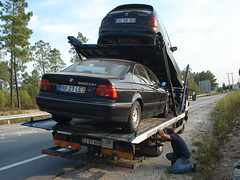
More stuck things [in Portugal]


So here's how the story goes: Let's assume you need to go somewhere, in Lisbon. By car. And you park it. [... time passes... ...] A while later, you get back to your car, and what do you see? Yeah, probably you'll take a second look. And think it over. ... But yes, it's true! The car's in rather than on the road.
... Wouldn't want to be you!

Credits for the photo go here.

Labels: ,

Friday, July 17, 2009

Panteão Nacional: part ii

In 1966, during the government of the Dictator António de Oliveira Salazar, the Church of Santa Engrácia was turned into a National Pantheon. The personalities buried here include the Presidents of the Republic Manuel de Arriaga, Teófilo Braga, Sidónio Pais and Óscar Carmona, Presidential candidate Humberto Delgado, writers João de Deus, Almeida Garrett, Guerra Junqueiro and Aquilino Ribeiro and fado singer Amália Rodrigues. There are cenotaphs to Luís de Camões, Pedro Álvares Cabral, Afonso de Albuquerque, Nuno Álvares Pereira, Vasco da Gama and Henry the Navigator.
[from here]
... and this is how I've learnt of Humberto Delgado:

Although initially a staunch supporter of the right-wing dictatorship of António de Oliveira Salazar, and the youngest general in Portuguese history, his passage as a Military Attaché and Aeronautic Attaché to the Portuguese Embassy in Washington, D.C. in 1952 pushed him into the defence of democratic ideals, and inspired him to run as a candidate to the Portuguese presidency in 1958.
In a famous interview on 10 May 1958, in the Chave d'Ouro café, when asked what would be his attitude towards Salazar, he made one of the most famous quotations of Portuguese politics: Obviamente, demito-o! (Obviously, I'll sack him!).
His outspoken attitude earned him the epithet of General sem Medo (Fearless General).
He was nevertheless credited with only around 25% of the votes in the highly rigged presidential elections of 1958, despite the consensual opinion that he was the true winner and some evidence of ballots filled with votes for the regime candidate by the secret police.
He was expelled from the Portuguese military, and took refuge in the Brazilian embassy before going into exile. [...]
In 1964, he founded the Portuguese National Liberation Front in Rome. [...]
Delgado and his Brazilian secretary, Arajaryr Moreira de Campos, would be murdered on 13 February 1965, after being attracted to an ambush by the regime's secret police (PIDE) near the border town of Olivenza, when trying to enter Portugal clandestinely. The official version was that he was killed in self defense, but he was not even armed when he was shot, and his secretary was strangled. Their bodies would only be found some two months later, near the Spanish village of Villanueva del Fresno. [...]
In 1990, Humberto Delgado was posthumously promoted to Marshal of the Portuguese Air Force - being the only person to hold this rank -, his name was given to an Avenue in Lisbon and his body was moved to the National Pantheon, in Lisbon. The significance of this gesture is that some former Portuguese Presidents are there.
[from here.]
Why write all of these here?
Because I found it to be representative of respectfulness, in its widest understanding, and because I found it impressive: certain errors may be [even if only marginally] corrected posthumously, from what it appears. And this has the potential of being a lesson for many, individuals and peoples alike.
[Photos from my flickr.]

Labels: , , , , ,

Wednesday, July 15, 2009

One Glorious Sunday Morning We Visited Panteão Nacional in Lisbon


The Church of Santa Engrácia is a 17th century monument of the city of Lisbon, in Portugal. In the 20th century the church has been converted into the National Pantheon (Panteão Nacional), in which important Portuguese personalities are buried. It is located in the neighbourhood of Alfama, close to another important Lisbon monument, the Monastery of São Vicente de Fora. [...]
The first church dedicated to the Saint was sponsored by Princess Maria, daughter of King Manuel I, around 1568. In 1681, building of the current church began after previous structures collapsed. The author of the new design was João Antunes, royal architect and one of the most important baroque architects of Portugal.
Building work proceeded from 1682 through 1712, when the architect died. King John V lost interest in the church, concentrating his resources in the gigantic Convent of Mafra. The church was left unfinished until the 20th century, so that Obras de Santa Engrácia (lit. Saint Engrácia's works) has become a Portuguese synonym for long unfinished works. Eventually a dome was added, whereupon the church was reinaugurated in 1966.
Excerpt from the Wiki entry: here.
More shots as taken by me: here.

Labels: , , , ,

Monday, June 01, 2009

[Re-]Tracing the Templars' Passage

Castelo de Almourol: Almourol Castle

Labels: , , , ,

Thursday, May 21, 2009

Scatman: remember

Labels: ,

Friday, March 13, 2009

Tomar: part ii

The gridded streets of the old town converge on the central Praça da República.
Here stands an elegant seventeenth-century town hall, a ring of houses of the same period and the church of São João Baptista, remarkable for its octagonal belfry, elaborate Manueline doorway and six religious panels attributed to Gregório Lopes, one of the finest artists to emerge from the so-called "Portuguese School" of the sixteenth century.
Nearby is an excellently preserved fifteenth-century synagogue*, now the Museu Luso-Hebraico Abraham Zacuto, named after the Spanish astronomer, Abraham Zacuto, who prepared navigational aids for Vasco da Gama. Its stark interior, with plain vaults supported by four slender columns, houses a collection of thirteenth- to fourteenth-century Hebraic inscriptions, but the interest lies more in its very survival in a town dominated for so long by crusading Christian Defenders of the Faith. In 1496 Dom Manuel followed the example of the Catholic Kings of Spain and ordered the conversion or expulsion of all Portuguese Jews. The synagogue at Tomar was one of the very few to survive so far south
* and the very first I have visited, which makes it much more special.

Lastly, one more town image deserves to be added for the mere reason that it's unvisited, slightly remote and generally a pleasure to the eye: the out-of-the-city-centre church of St. Maria dos Olivais - next to which archaeological works are still in progress.

Out of town, the highlight is the stunning seventeenth-century Aqueduto Pegões, built to supply the convent with water.
Walking to this place was the best choice for a Saturday morning and, oh boy, that was definitely worth! Here's why: the very first aqueduct I got to climb on, and enough to get me feeling the wind's breeze instilling a sense of ... well, take-off!
To sum it up, this was a great place to spend the 50h we've dedicated and possibly a place to return. A reminder is however useful: bring along some extra memory for the photos - it'll be missed!
Once again, guiding lines picked up from here.
And, once again, extra photos are located here.

Labels: , , ,

Monday, March 09, 2009

Tomar: part i

The Convento de Cristo at Tomar, 34km east of Fátima, is an artistic tour de force which entwines the most outstanding military, religious and imperial strands in the history of Portugal. The Order of the Knights Templar* and their successors, the Order of Christ, established their headquarters here and successive Grand Masters employed experts in Romanesque, Manueline and Renaissance architecture to embellish and expand the convent in a manner worthy of their power, prestige and wealth.
In addition, Tomar is a handsome small town in its own right, well worth a couple of days of slow exploration. Built on a simple grid plan, it is split in two by the Rio Nabão, with almost everything of interest on the west bank. Here, Tomar's old quarters preserve much of their traditional charm, with whitewashed, terraced cottages lining narrow cobbled streets that frame the convent above.
* See Dom Gualdim Pais (1118 – 1195), founder of the Castle of Tomar in 1160, here.

This is what my Rough Guide told me, and yes, the tingly sensation of excitement was prompt to arrive whilst embarking the train;
the great wheather, the friendliness of the locals and the affordable prices have all been happiness-inducing factors and, for things to get even better, the city seemed to have a rather small density of tourists per square km, giving the photo-freak in me plenty of space and time to collect them images:
Unfortunately, the Charola of the Knights Templar [the 'sacred heart of the whole complex, also known as the Rotunda or Templars' Apse'] constituted the subject of repairs at the time of our visit, so I couldn't even glance at it, let alone photograph it.
Nonetheless, I could catch the ex libris of the place, the Manueline style window (left, below), as well as the old cloister (right, below), as you may note:

Whilst writing these notes, selecting only a few images seems almost wrong and definitely difficult, as I keep focusing and being absorbed by the Convent and its many thought/admiration-enticing details, despite it not having been my intention;


... that's only because of its grand and overwhelming architecture and level of detail, which doesn't allow the easy passage to other features of the city; here's my only solution: Tomar will have a second dedicated post.

For (a few) more images, take a look here.

Labels: , , ,

Saturday, February 07, 2009

Retrospectively: Óbidos | Lizzo Day 310

[This long-overdue tale pertains to a trip undertaken back in a November Saturday, to a place known as Óbidos.]
As we were supposed to get the train to meet D.&T., the time to be spent at the station helped the useful purchase of a children's book on the topic; as it turned out, this included an audiobook, which very much speeded up the passage of time in the car, on the way to our destination:Unfortunately, I can't exactly upload the cd's contents, as this might oversimplify the tale's perspective; still, I can share some of the story behind:
Óbidos is known as the "Wedding City" and was the traditional bridal gift of the kings of Portugal to their queens, a custom started in 1282 by Don Dinis and Dona Isabel. It is a very small town, completely enclosed by lofty walls, and although much was rebuilt after the 1755 earthquake, Óbidos retains a medieval feel: cobbled alleys, withewashed houses framed with bright blue and yellow borders, and steep stairecaseswinding up to the exposed ramparts for distant views. 500 years ago, when Peniche was an island, the sea also reached the foot of the ridge on which Óbidos stands and boats were moored below its walls. However, by the 15th century the sea had retreated, leaving a fertile green plain and the distant Lagoa de Óbidos with its narrow, shallow entrance to the sea.
[as put by my Rough Guide to Portugal, p. 185]
Let me demonstrate:
Other than the royal tradition and the views, we've come to learn that this is a place famous for its chocolate Festivals and its ginjinha em copos de chocolate [chocolate-cups-cherry]:

...and such was a perfect late autumn's Saturday (:

P.S. Oh, and Here's the Castle, in case you were wondering about that lil' detail..

Labels: , , ,